
Rising caesarean rates, birth trauma, and what the data misses
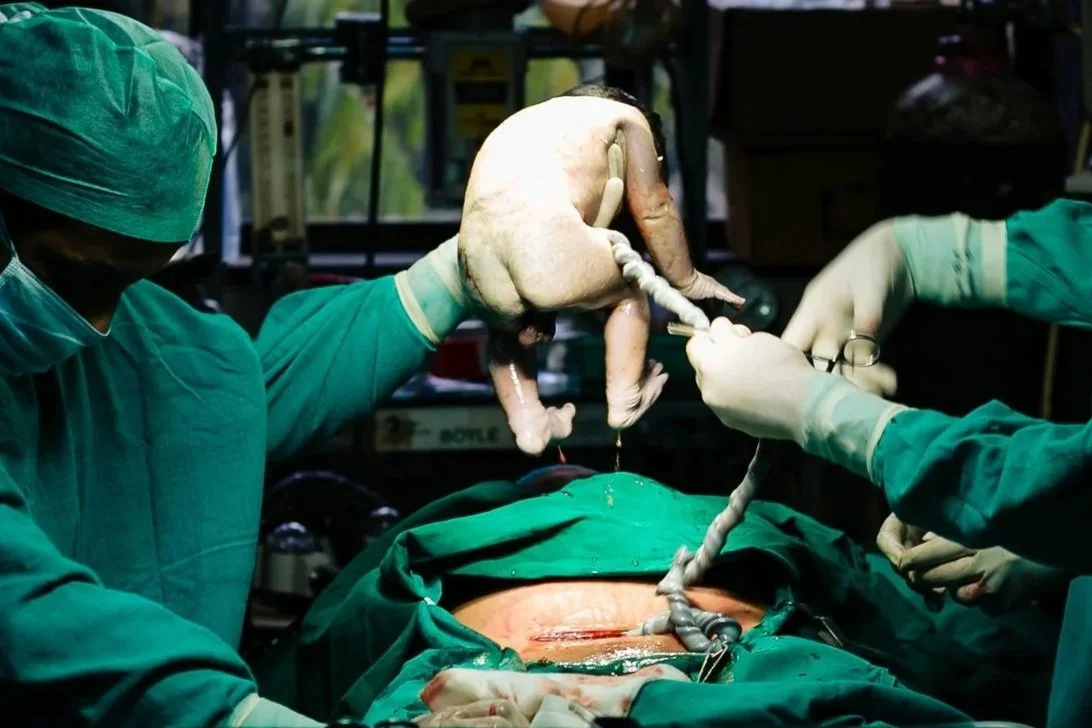
Half of all babies born in English NHS hospitals now are extracted via caesarean section. Recent monthly figures put emergency caesareans alone at over a quarter of all births, and yet stillbirth and neonatal mortality rates have not improved at the same pace as intervention rates have risen.
Something is up.
The standard explanations include workforce shortages, litigation fears and the long shadow of maternity safety scandals, all of which are real, but these aren’t the whole picture. They describe institutional pressures without asking what is happening to the women and birthing people inside those institutions or what is driving the quiet, steady loss of confidence in physiological birth that underlies so many of them.
When safety becomes surgery
Requesting a caesarean section is, for most people, primarily an emotional decision. Scamell’s investigation into decision-making in childbirth within the risk society, positions caesarean section as a social and moral experience shaped by fear, anxiety, uncertainty and the promise of safety. It is what happens when someone has watched friends describe frightening, unsupported births and concluded that labour is something to be survived rather than moved through in an empowered way, or when a previous birth has left something unresolved that cannot be faced again. when the system has communicated, through rushed appointments, unfamiliar faces, and decisions made without explanation, that the person's body cannot be trusted, then intervention is the responsible choice.
A maternal request caesarean is a rational response to a system that has progressively withdrawn the conditions that make physiological birth feel possible. When someone does not trust that they will be known, held and supported through labour, they choose certainty, because however significant major abdominal surgery is, it feels more controllable than a system that cannot be relied upon.
This loss of confidence is perfectly rational as it reflects lived experience, of care that changed hands too many times, of being left alone at critical moments, of not being listened to, of interventions that happened without full explanation or proper consent. Then these experiences can become birth trauma.
Birth trauma and the caesarean rate
The connection between birth trauma and rising caesarean rates is rarely named explicitly, though it definitely should be.
Research suggests that between 20 and 48% of women and birthing people in UK describe their birth as traumatic (Greenfield et al). Globally, 4 to 5% meet criteria for PTSD following childbirth, roughly 25,000 to 30,000 people every year (Ayers et al). Many more carry difficult experiences that fall below that clinical threshold but profoundly shape their subsequent choices.
A person who experienced a traumatic first birth, who carries intrusive memories, hypervigilance, or a deep sense that their body failed them or was failed by those around them, faces a subsequent pregnancy in a fundamentally different position. The nervous system, still holding an unresolved experience, responds to the prospect of labour as a known threat. Requesting a caesarean is, in that context, a survival response.
This is one of the most significant and least-discussed drivers of rising caesarean rates. Until birth trauma is taken seriously, until people receive real, relational, trauma-informed support after difficult births, those experiences will continue to shape subsequent birth choices in ways the data captures but doesn’t explain.
Antenatal education, another ‘nice-to-have’ that has been widely cut from service provision, is an important piece in this puzzle. It is proven to reduce fear of childbirth, build self-efficacy, and sense of control in birth, and lower PTSD symptoms following birth (Gökçe İsbir et al) and reduce planned caesarean rates (Hooper et al). It makes sense that when people understand what labour does physiologically, when they have practised responses to pain and uncertainty, when they have met their nervous system needs before the moment of crisis, they are less likely to experience birth as something that happened to them, and feel better resourced to cope. How unbelievably short-sighted, then, for NHS Trusts to cut this protective birth preparation, to not see how intrinsic antenatal education is to compassionate, trauma-informed person-centred care. Yet another example of a budget-saving decision that has disastrous long term consequences, some of which are reflected in the caesarean data and the birth trauma data.
The institutional logic of intervention
The forces driving caesarean rates are structural as well as personal. Clinicians in England work within systems shaped by formal inquiries and the ever-present threat of litigation following adverse outcomes. The investigations into maternity failures at Morecambe Bay, East Kent and Shrewsbury, and now Nottingham, have contributed to a clinical environment in which deviation from protocol feels professionally dangerous. The Ockenden report into Nottingham found that women were coerced into interventions “framed as non-negotiable due to ‘policy’” and described “defensive behaviour from staff” as normalised (Ockenden). If a healthcare practitioner will face less retribution for doing too much too soon than too little too late, then caesarean section becomes a mechanism for managing uncertainty and distributing responsibility as much as a clinical decision. Inquiries into maternity failures are necessary of course, but the lessons the system appears to perennially take are never that continuity and relational care save lives (which is what the evidence shows), but that more intervention and more medicalisation is safer.
The pressures on individual clinicians and on individual women and birthing people are different expressions of the same broken system. Midwives who cannot practise with continuity, who cannot build the relational trust that enables someone to feel safe in labour, who are managing caseloads that make unhurried person-centred care structurally impossible, are also part of this picture. A system that produces burned-out midwives and traumatised women and birthing people will produce higher caesarean rates.
The cost
Emergency caesareans remain necessary, vital and often life-saving. The question is what do rising rates tell us about the state of the system, and what do they cost?
Physically, recovery is significant and frequently underestimated: symptoms varying from chronic pain, restricted mobility, disrupted bonding and emotional distress in the weeks and months after birth are commonly reported. Much of that recovery is managed by women and families at home, with minimal support.
Emotionally, caesarean birth, both planned and emergency, can itself be a source of birth trauma (Turk et al). The loss of a hoped-for experience, the shock of emergency surgery, the feeling of passivity or absence from one's own birth, the difficulty making sense of what happened are common (Clement );(Lemola). For many people who have had them, caesarean birth is neither easier nor less traumatic than they expected.
What would actually change things
The 2024 Cochrane systematic review on midwifery continuity of care (Sandall et al.) found that continuity models were associated with fewer caesarean sections, fewer instrumental births, more positive experiences and cost savings. The evidence is clear and consistent that those who feel known and held are less likely to need or request intervention.
Antenatal education needs to be elevated from a disposable supplementary offering to its rightful status as a mechanism by which people arrive at labour with the physiological literacy and psychological resources to move through it rather than be overwhelmed by it.
Group antenatal education also builds community, which has extensive benefits way beyond the birth itself: women and birthing people with strong social support networks manage stress better and are generally healthier than those without, and group antenatal psychoeducation has been shown to improve postnatal social support significantly. (Tessema et al)
Routinely cutting antenatal education when maternity budgets are squeezed is a category error (ie it has been filed under ‘discretionary extras’ when it belongs under ‘clinical infrastructure’) and it reveals how birth is understood within the system: if birth is a medical event managed by clinicians, antenatal education is optional. If on the other hand, birth is a holistic event in someone’s life, something they can be prepared for, supported through and helped to integrate afterwards, then withdrawing that preparation is not a neutral efficiency saving, but a decision with clinical consequences.
Taking birth trauma seriously is the other important piece: providing real, relational, trauma-informed support after difficult births reduces the likelihood that one traumatic birth shapes the next pregnancy, and the choices that follow from it.
All these are straightforward in principle and being dismantled in practice, with birth units closing, community midwifery being reconfigured, antenatal education axed and the decimation of postnatal care. The conditions that make physiological birth possible and safe are being withdrawn, and the caesarean rate is rising in direct proportion, surely we can see this is a consequence, not a coincidence? Until it is named as such, at every level where these decisions are made, the caesarean section rate will continue to rise.
References
Scamell, M. Childbirth Within the Risk Society. Sociology Compass, 2014, 8: 917-928.
Greenfield M, Jomeen J, Glover L. What is traumatic birth? A concept analysis and literature review. British Journal of Midwifery. 2016;24(4):254–267.
Ayers S, Bond R, Bertullies S, Wijma K. The aetiology of post-traumatic stress following childbirth: a meta-analysis and theoretical framework. Psychological Medicine. 2016;46(6):1121–1134.
Gökçe İsbir G, İnci F, Önal H, Yıldız PD. The effects of antenatal education on fear of childbirth, maternal self-efficacy and post-traumatic stress disorder (PTSD) symptoms following childbirth: an experimental study. Appl Nurs Res. 2016 Nov;32:227-232. doi: 10.1016/j.apnr.2016.07.013. Epub 2016 Jul 30. PMID: 27969033.
Hooper, Mechkaroff, Upitis, Schofield, Carland, Henry. The effectiveness of antenatal education on improving labour and birth outcomes – A systematic review and meta-analysis, Women and Birth, Volume 38, Issue 1, 2025, 101843,
Ockenden D. Findings, conclusions and essential actions from the Independent Review of Maternity Services at Nottingham University Hospitals NHS Trust. London: DHSC; 2026.
Türk R, Harder U, König-Bachmann M. Post-traumatic stress syndromes following childbirth influenced by birth mode — is an emergency caesarean section worst? Archives of Gynecology and Obstetrics. 2023;308:1117–1125.
Lemola S, Stadlmayr W, Grob A. Maternal adjustment five months after birth: the impact of the subjective experience of childbirth and emotional support from the partner. Journal of Reproductive and Infant Psychology. 2007;25(3):190–202.
Clement S. Psychological aspects of caesarean section. Best Practice and Research Clinical Obstetrics and Gynaecology. 2001;15(1):109–123.
Sandall J, Fernandez Turienzo C, Devane D, Soltani H, Gillespie P, Gates S et al. Midwife continuity of care models versus other models of care for childbearing women. Cochrane Database of Systematic Reviews 2024, Issue 4. Art. No.: CD004667.
Tessema M, Abera M and Birhanu Z (2025) Improving postnatal social support using antenatal group-based psychoeducation: a cluster randomized controlled trial. Front. Glob. Women's Health 6:1510725. doi: 10.3389/fgwh.2025.1510725
