
Matrescence, metamorphosis and eels
Twenty-three years ago, I came to Croatia pregnant with my first daughter. This week I returned, and sitting beside the Adriatic, I’ve finally begun Matrescence by Lucy Jones, a book that countless people on my caseload have recommended over the past three years.¹
Beautifully written, deeply personal and meticulously researched, Jones gives space to the profound transformation of pregnancy, weaving her own experience with neuroscience, anthropology, feminist scholarship and the wider politics of motherhood.
I think about how this is exactly the conversation maternity care struggles to make room for and yet the philosophy of midwifery is inherently holistic and we aspire to care for the whole person, recognising that pregnancy reverberates through every dimension of life. Sadly, increasing demands on maternity services mean that care becomes reduced to measurements, screening, documentation and risk management. No time for the wider narrative that pregnancy is not simply a biological or medical event to be monitored and managed.
Jones draws a compelling parallel between matrescence and adolescence.¹ The term matrescence itself was first coined by the anthropologist Dana Raphael in the 1970s to describe the developmental transition into motherhood.² Since then, researchers have increasingly recognised pregnancy and the postnatal period as times of profound neurological, hormonal, psychological and social change.³⁻⁵
As someone who spends much of my working life supporting people after birth, this resonates deeply. So many of the women and birthing people I meet aren’t only trying to understand what happened during birth, they’re trying to understand who they have become, which is what makes Matrescence feel so important.
Jones argues that pregnancy is way more than producing a baby, it’s a developmental process that completely reconfigures the person carrying that baby. Drawing on neuroscience, evolutionary biology, psychology, anthropology and feminist scholarship, she explores how pregnancy and early parenthood alter the brain, the endocrine system, relationships, identity, ambition, creativity and our place in society. Rather than treating these changes as incidental, she asks us to recognise them as a distinct life stage, every bit as radical as adolescence. In doing so, she challenges a culture that expects people to emerge from pregnancy fundamentally unchanged, which flattens and belittles the enormous story of becoming we go through.
More than motherhood?
Just as Jones invites us to rethink pregnancy as a developmental stage, we might also rethink who gets included within that story of becoming. She writes primarily from the perspective of becoming a woman and becoming a mother, which makes sense as that is, after all, her own story.
Elsewhere she has acknowledged that transgender and non-binary people become pregnant and give birth. Although their experiences of matrescence are not explored in the book she has spoken supportively on this.⁶
I wonder if matrescence might be understood not simply as the transition into motherhood, but as a concept that embraces both the embodied transformation of pregnancy and the profound psychological, relational and existential transition into parenthood.
For those who experience pregnancy, that journey is shaped by extraordinary neurobiological, hormonal and physiological adaptations alongside changes in identity and relationships. Becoming a parent can also be deeply transformative for those who do not carry a pregnancy, including many adoptive parents and non-gestational mothers, whose sense of self, family and belonging may be reshaped just as profoundly, albeit through different pathways.
For trans and non-binary people who become pregnant, this journey can involve additional layers of complexity: navigating body dysphoria, moving through maternity systems that remain deeply gendered, finding language that reflects who they are rather than assumptions made about them, and seeking communities where their experiences are recognised and affirmed.⁷⁻⁹ Some writers have begun describing these experiences as queer matrescence.⁸
Alongside this, queer scholars have offered thoughtful critiques of the concept of matrescence itself. Some argue that, because it has largely been theorised as the transition into motherhood, it risks centring cisgender, biological and heteronormative understandings of pregnancy and family life.⁸⁻¹⁰ They ask whether this inadvertently sidelines adoptive parents, non-gestational mothers, surrogate mothers, trans men, non-binary people and others whose journeys into parenthood do not fit cis-heteronormative narratives.
Shelley M. Park's concept of monomaternalism offers another lens through which to view this discussion. She describes the deeply embedded cultural assumption that there is one "real" mother, typically understood as the gestational mother.¹¹ While pregnancy is undeniably a unique embodied experience, this perspective invites us to question whether our language of becoming might also recognise the profound identity transitions of those who become parents through other pathways.
These critiques are not arguments against recognising the profound transformation of pregnancy. Rather, they invite us to consider whether the concept of matrescence itself might evolve to honour both the unique embodied experience of pregnancy and the many different ways people become parents. The power of Matrescence lies in recognising becoming as worthy of attention.
As a midwife, I don’t want us to lose sight of the extraordinary neurobiological and psychosocial transformation that pregnancy brings. Perhaps, then, the challenge is not whether we abandon the concept of matrescence, but whether we make space for it to evolve. We need language that honours the remarkable neurobiological transformation of pregnancy without reducing parenthood to biology alone; language that recognises pregnancy as a unique embodied experience while also making space for the equally profound identity transitions of those who become parents through other routes. An inclusive understanding of matrescence need not erase difference; but rather, ensure that the language we use to understand the transformation is inclusive enough to encompass everyone who experiences it.
The eel
Jones briefly invokes the European eel, whose extraordinary journey and repeated metamorphoses become a quiet metaphor for transformation itself. It caught me by surprise, made me smile and feel momentarily like a terrible cliché.
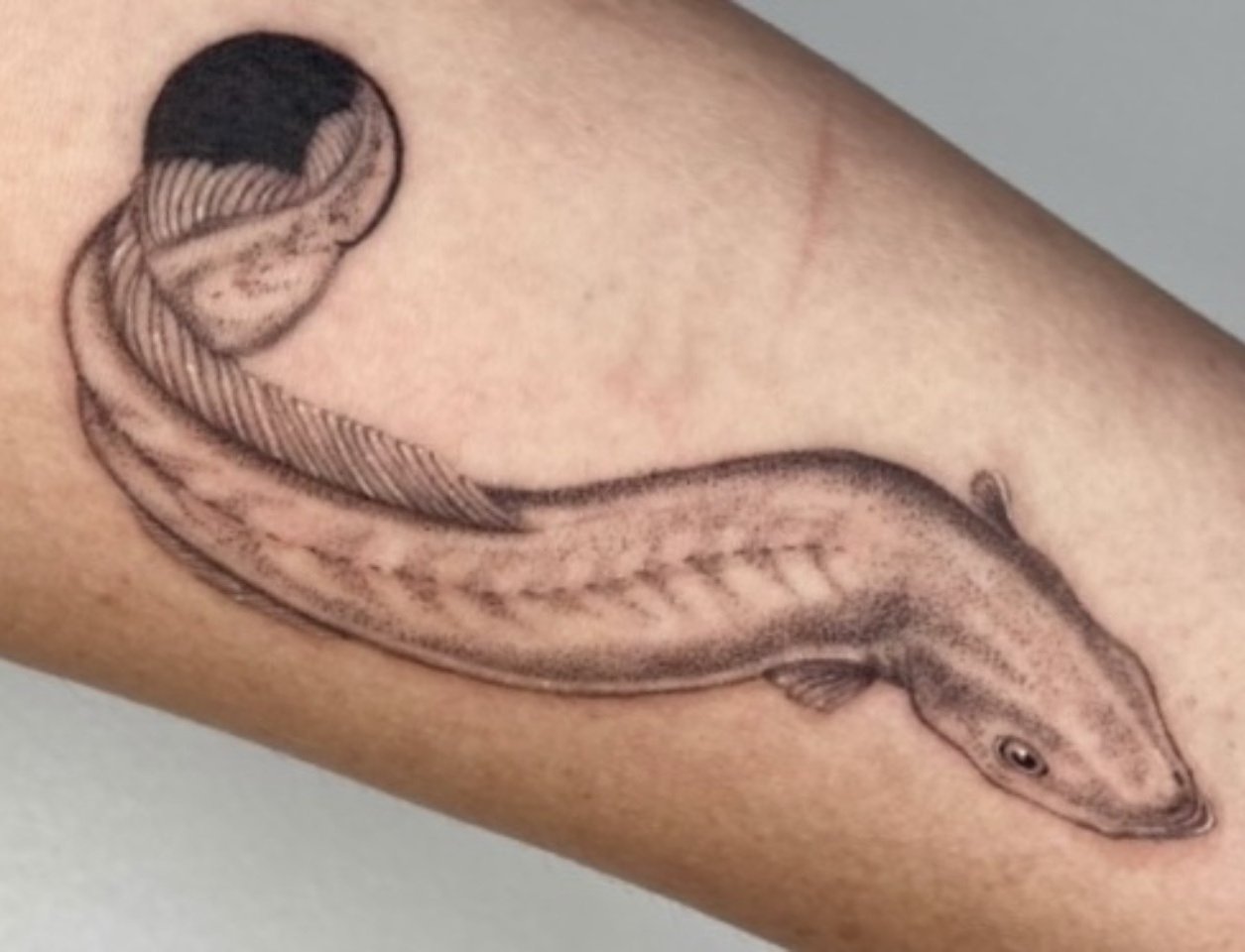
Six years ago, during my own perimenopause, I had an eel tattooed on my arm. I hadn’t read about eel symbolism, but became fascinated by this extraordinary creature and what it represented to me: migration, mystery and transformation.
Perhaps that’s why hearing the eel mentioned here, in Croatia, the place I last visited while carrying my first child, felt unexpectedly poignant.
Pregnancy. Birth. Parenthood. Perimenopause. Grief. Healing. They’re all connected, all long journeys of loss and becoming, much of which happens beneath the surface, invisible to everyone else. The eel continues to resonate with me, luckily.
Looking forward
I’m part way through Matrescence, and suspect I’ll return to it many times. It offers a language for something our culture has too long overlooked: that pregnancy changes us, not only physically, but neurologically, psychologically, socially and existentially.
As our understanding continues to evolve, I hope the language evolves too, becoming spacious enough to recognise the many ways people experience pregnancy, birth and the transition into parenthood, without implying biology or gestation are more authentic routes.
Metamorphosis belongs to all of us, however it reveals itself, quietly, hidden or dramatically and visible to all
References
1. Jones L. Matrescence: On the Metamorphosis of Pregnancy, Childbirth and Motherhood. London: Allen Lane; 2023.
2. Raphael D. The Tender Gift: Breastfeeding. New York: Schocken Books; 1973.
3. Stern DN, Bruschweiler-Stern N, Freeland A. The Birth of a Mother: How the Motherhood Experience Changes You Forever. New York: Basic Books; 1998.
4. Hoekzema E, Barba-Müller E, Pozzobon C, et al. Pregnancy leads to long-lasting changes in human brain structure. Nat Neurosci. 2017;20(2):287–296.
5. Barba-Müller E, Craddock S, Carmona S, Hoekzema E. Brain plasticity in pregnancy and the postpartum period: Links to maternal caregiving and mental health. Nat Rev Neurosci. 2019;20:123–137.
6. Jones L. Instagram post acknowledging that transgender and non-binary people can become pregnant and give birth. 2023.
7. Ellis SA, Wojnar DM, Pettinato M. Conception, pregnancy, and birth experiences of male and gender-expansive gestational parents. J Midwifery Womens Health. 2015;60(1):62–69.
8. Belc KM. The Natural Mother of the Child: A Memoir of Nonbinary Parenthood. Berkeley: Counterpoint; 2021.
9. Hoffkling A, Obedin-Maliver J, Sevelius J. From erasure to opportunity: A qualitative study of the experiences of transgender men around pregnancy and recommendations for providers. BMC Pregnancy Childbirth. 2017;17(Suppl 2):332.
10. Halberstam J. In a Queer Time and Place: Transgender Bodies, Subcultural Lives. New York: New York University Press; 2005.
11. Park SM. Mothering Queerly, Queering Motherhood: Resisting Monomaternalism in Adoptive, Lesbian, Blended, and Polygamous Families. Albany, NY: State University of New York Press; 2013.
