
Joy Clarke: fifty years fighting FGM
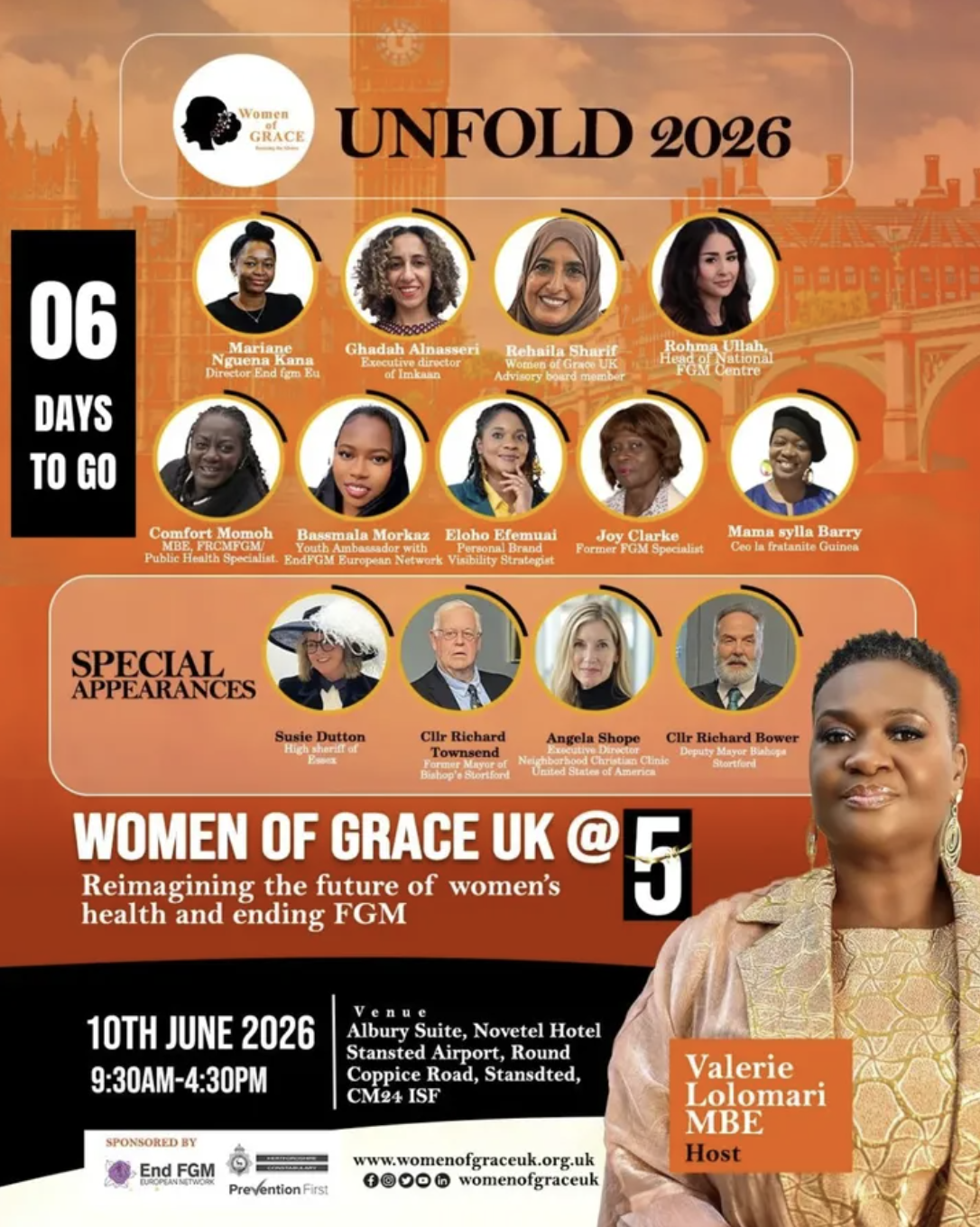
Joy Clarke is speaking at UNFOLD 2026, Women of Grace UK's annual conference on ending FGM. 10 June 2026, Novotel Stansted Airport. Details at womenofgrace.org.uk
Published to mark the International Day of Zero Tolerance for Female Genital Mutilation, 6 February. [Originally published in MIDWIFERY MATTERS, issue 169, June 2021]
Can you describe the moment you decided to become a midwife?
My journey into midwifery was accidental. In 1975, after doing State Registered Nursing, the plan was to do Mental Health nursing, but instead of waiting 6 months, I trained as a midwife at the Whittington Hospital in London and I’ve never looked back
How was it?
Well, we did it in two parts, each of 6 months, very different in those days. We had to sterilise and boil wash our instruments, then place them on the trolley for the next delivery - a lot of hot work and steam! Students weren’t allowed to be married or have babies.
What about interprofessional relationships?
Bullying from doctors was rife. They felt they could speak to students however they liked. To this day I recall the injustice of being sent out of a lecture because some students at the back were talking, and the consultant singled me out and reprimanded me. I stood up for myself and refused to leave. Throughout my career I have never held back if I see discrimination, amongst my colleagues and the women.
So your heart is in advocacy?
Yes, that’s why midwives are so important, especially for minoritised ethnic groups. If their cultural mentality reveres doctors as gods, they enter the maternity system with these attitudes and do not feel empowered. I try to be the voice for the voiceless, to advocate for women who are afraid to speak for themselves, who don’t have the confidence to speak to doctors, antenatally or during the birth
Never more important than in your FGM work. You’ve done a lot of work on raising awareness and supporting women with FGM, especially setting up African Well-Women’s Clinic. How did all that start?
Again, by accident really. In, 1995 a woman came in in advanced second stage labour, the baby’s hair showing through a 1cm hole that had been left after type III FGM. An emergency deinfibulation was performed and the FGM service took off after that. There’s still no consensus on the best timing of deinfibulation for childbirth in women with type III FGM (Esu et al, 2017). With my colleague, Georgina Sousa, we set about learning how to start a clinic for women with FGM. We visited Harry Gordon and learnt all about how to do deinfibulation. We visited Comfort Momoh and Professor Ryman and took all the info back to the Whittington, how to specialise, how to advertise the service, make the booklet and so on. I’ve retired from clinical practice but the midwifery-led African Well- Women’s Clinic is still going, still supporting and improving maternity care and outcomes for childbearing women with female genital mutilation. Both pregnant and non- pregnant women can access it and we aimed to see women within two weeks of their referral. The clinic offers advice, counselling, antenatal care and assessment, de-infibulation, post- surgery and post natal follow up. Home visits are offered to women living in the borough of Islington and Haringey
More than 200 million girls and women have undergone female genital mutilation worldwide, and another 30 million are at risk
of being cut over the next decade — yet few interventions have focused on stopping the practice, and previous United Nations targets and pledges to end FGM within a generation have failed.
You were nominated for innovative practice for FGM home service by the Commission for Health Improvement. Amazing, tell us about that
Home is the best place for FGM consultations, it’s more private and we can ask permission for other family members to be present in the discussion. Travelling to clinic can be a problem for already vulnerable women - so take the service to the women, it’s better.
In the last 30 years, worldwide FGM rates have fallen thanks to new laws and dedicated advocacy, but what else needs to happen?
There has been an overall decline in the prevalence of FGM over the last three decades, but not all countries have made progress and the pace of decline has been uneven2. We need to continue raising awareness within communities. Sadly during lockdown, two million more girls were potentially subjected to FGM because they were not in school and under the radar, no safe spaces temporarily.
How significant is the recent FGM prosecution in the U.K. for the campaign?
It was significant to a point but that child only got found out as she was taken to hospital due to bleeding. Older members are likely to do the cutting. We need to encourage mothers to access social services to protect vulnerable girls. Now a lot of younger people are coming out to talk about the process, the hope is that by 2030 FGM will be eradicated. We’ll only know when a young woman is pregnant. It is changing, I know of numerous families of daughters with previous daughters born outsideUK who had FGM but subsequent daughters born in UK have not had FGM - so this is progress.
What campaigns are you involved with now?
I'm doing some training on harmful practices involving FGM, early forced marriage, domestic abuse and child abuse linked to faith. I’m also doing a talk for Leyla Hussein on breast ironing - an extremely harmful practice in Cameroon and West African countries - intended to prevent girls becoming noticed by men.
As a Black leader, what is your perspective on racism within midwifery?
It’s always been there. Some ethnic minority women are afraid because previously when they’ve spoken up they haven't been honoured or acted upon. I’ve seen this happening, but unless women speak up for themselves the biases persist. Women must question anything that doesn’t feel right, and we need to be very careful how we speak to, and most importantly how we listen to women. Everyone in maternity should read Candice Braithwaite's ‘I am not your baby mother’ - it’s a very powerful account of a black British mother's experience.
MBBRACE highlighted the extreme disparities in healthcare, which points at structural racism. And as Prof Donna Kinnair says, health service is failing people of colour – both those using it and its workforce - what more can we do?
Keep being vocal wherever we see unfairness or injustice, nerve turn a blind eye, and keep focused on the women. Listen to the woman, let the woman take control of the situation.
Who are your guides and role models historical and living who have paved a way and deeply influenced you and your work?
My midwifery role models were Mary McKone and Mrs Watts who taught me when we were students living in St Anns accommodation. During Part II of the training we were initially assigned to a community midwife. The midwife would send the student ahead to the birth, so we were there and the baby would often arrive before the midwife - we really learnt on the ‘on the job’ - Haringey homebirth rate was 6% at the time.
I remember when you were my midwife, homebirth felt like the default option. How it was presented so naturally, gave me the confidence in that choice for my first baby. By my second and third it was a no-brainer
Well, why would a healthy young woman having a straightforward pregnancy, opt to go into hospital? Being at home gives the woman more control and privacy, it’s unlikely there’ll be others coming in disturbing the flow of labour. And it’s also very important for the partner to be involved.
And finally, radical midwifery - what does it mean?
I didn’t see myself as radical - though perhaps I am on the quiet. Know your job, be up to date with the research so we can better support and advocate for women. The importance of giving them up to date information can’t be emphasised enough. Going outside the guidelines is radical, for example homebirth after caesarean, trusting women to know their bodies and know they can do it - I look at the whole picture, but not all professionals do, they only look at the fact of previous caesarean without asking why. It’s a radical approach to unpick each individual story and go deeper.
References
Esu E, Udo A, Okusanya BO, Agamse D, Meremikwu MM. (2017) 'Antepartum or intrapartum deinfibulation for childbirth in women with type III female genital mutilation: a systematic review and meta-analysis.' International Journal of Gynaecology and Obstetrics. February 2017
Unicef (2020) Female Genital Mutilation
Knight M, Bunch K, Tuffnell D, Shakespeare J, Kotnis R, Kenyon S, Kurinczuk JJ (Eds.) on behalf of MBRRACE-UK. Saving Lives, Improving Mothers' Care: Lessons learned to inform maternity care from the UK and Ireland Confidential Enquiries into Maternal Deaths and Morbidity 2016–18. Oxford: National Perinatal Epidemiology Unit, University of Oxford; 2020.
Kinnair D. (2020) 'Racism in the NHS: in every community, BAME patients suffer the most'. The Guardian. 10 June 202
